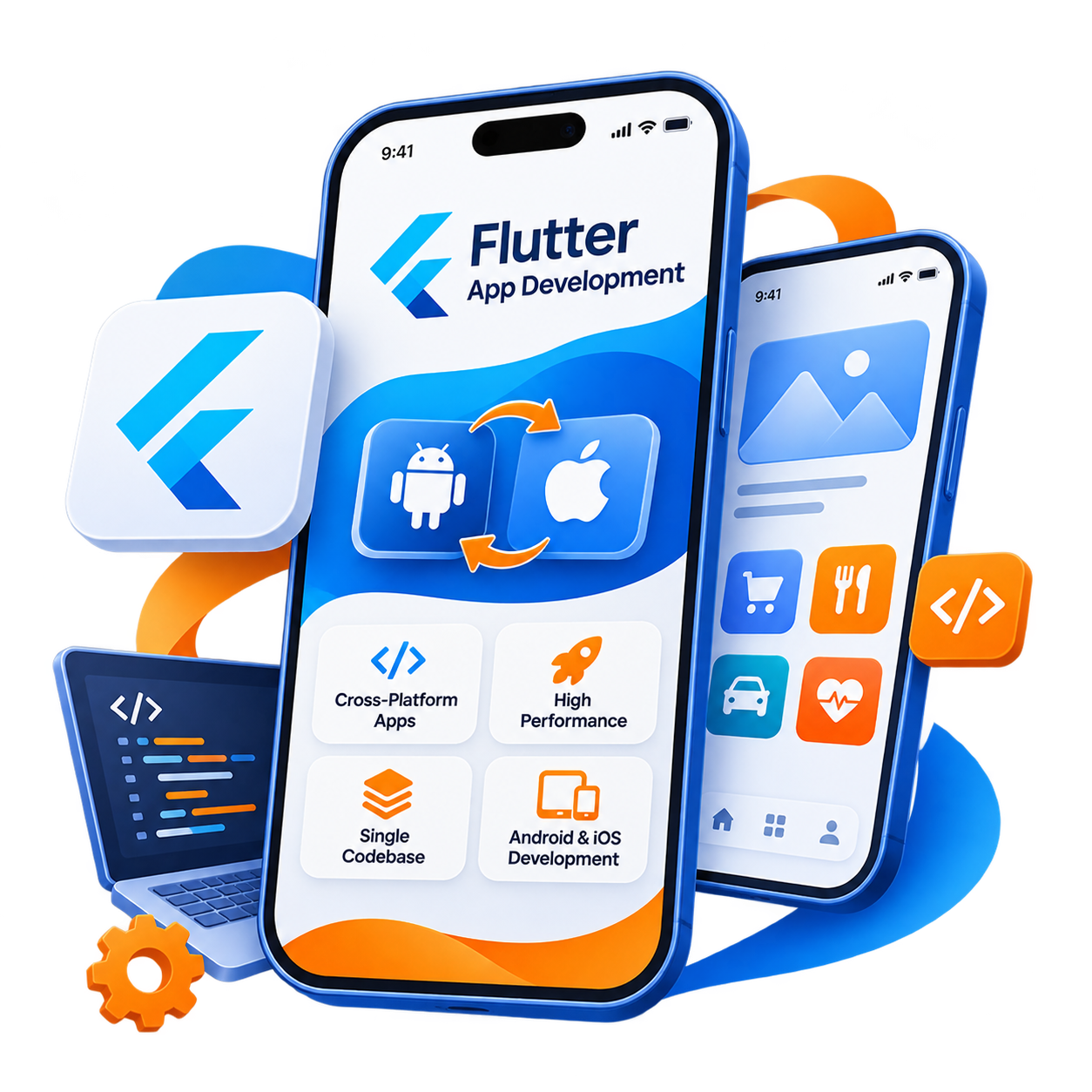
Build mobile applications for Android and iOS with a development approach tailored to your product, users, and business requirements. Codexxa develops custom Flutter apps with purposeful interfaces, connected systems, and functionality designed around your application goals.
Discuss your application concept, platform requirements, features, and technical priorities with our team.
Flutter is an open-source UI framework that uses Dart to build applications for multiple platforms from a shared codebase. It allows developers to create custom interfaces, reusable components, and consistent application experiences while integrating platform-specific functionality when required.
For businesses, Flutter can reduce the need to maintain entirely separate application codebases for Android and iOS. However, the right implementation still depends on device capabilities, integrations, performance requirements, and the complexity of the product.
Share much of the application logic and interface implementation across Android and iOS, reducing duplicated development work where appropriate.
Build interfaces using reusable Flutter widgets, supporting consistent layouts, custom visual elements, and structured screen components.
Connect to device features and platform APIs through plugins, platform channels, or native code where the application requires them.
Organise screens, state management, data access, and business logic to suit the application's complexity and maintenance needs.
Flutter can be a strong option when a product needs a consistent cross-platform experience, but the decision should reflect its technical demands.
Flutter allows teams to share substantial parts of an application across both platforms while adapting platform-specific details where necessary.
Its widget system supports custom layouts, branded interfaces, animations, and reusable design components.
Applications with common workflows, data rules, and user journeys can benefit from a shared implementation across supported platforms.
A structured Flutter codebase can support ongoing feature development when architecture, testing, and maintenance are planned appropriately.
Assess native integrations, plugin availability, platform restrictions, and performance requirements before selecting Flutter for technically demanding applications.
Flutter can support a wide range of mobile app functionality when paired with suitable backend services and integrations.
Create branded screens, interactive components, transitions, and responsive layouts for different device sizes.
Implement registration, sign-in, profile management, and access controls using suitable authentication services.
Connect the app to backend systems to retrieve, update, and synchronise application data.
Support reminders, account alerts, order updates, and other communications through appropriate notification or messaging services.
Integrate suitable payment gateways and transaction workflows according to the application's business model and provider requirements.
Use supported features such as GPS, cameras, file access, and biometrics where required and permitted.
Keep selected information available locally and synchronise changes when connectivity and application architecture allow.
Connect analytics tools and external services to support product measurement, operational workflows, and additional functionality.
From new app concepts to existing products, we tailor Flutter development to your platform needs, functionality, and technical scope.
Develop mobile applications around your business workflows, target users, functional requirements, and product roadmap.
Explore Service →Plan user journeys, screen layouts, navigation, and interactive elements before implementation begins.
Explore Service →Build for supported platforms using a shared Flutter codebase, with platform-specific adjustments where needed.
Explore Service →Connect your app with backend services, databases, authentication systems, and third-party APIs.
Explore Service →Improve an existing Flutter application by addressing outdated dependencies, interface issues, architecture concerns, or evolving requirements.
Explore Service →Evaluate application workflows, rendering performance, device compatibility, and integration behaviour to identify improvement opportunities.
Explore Service →Maintain app functionality through agreed bug fixes, dependency updates, compatibility improvements, and planned enhancements.
Explore Service →Each stage connects product decisions with implementation, validation, and release preparation.
Establish the app's purpose, target users, essential workflows, platform coverage, and integration requirements. Define the initial scope and identify technical dependencies.
Choose an appropriate application structure, state management approach, data strategy, and integration model based on the product's complexity.
Map key user journeys, design screen layouts, and establish reusable interface patterns before full implementation.
Implement application screens, business logic, data handling, and required connections with backend systems and platform services.
Validate core functionality, layouts, integrations, performance, and compatibility across the intended devices and operating system versions.
Prepare release builds and required submission materials. Plan updates and maintenance according to the agreed support scope.
Flutter can support customer-facing and operational applications across industries, depending on each product's performance, integration, and compliance requirements.
Build shopping experiences with product catalogues, search, carts, checkout, order tracking, and customer accounts.
Support appointment scheduling, patient-facing information, wellness tracking, and communication features where privacy and regulatory requirements are addressed.
Deliver learning content, course access, progress tracking, assessments, and notifications through a mobile interface.
Develop account interfaces, transaction workflows, payment features, and financial dashboards subject to security, integration, and regulatory requirements.
Connect service discovery, ordering, booking, status updates, location features, and customer communication.
Support job assignments, delivery status, location capture, task management, and field reporting based on operational needs.
Define your app requirements with our team and identify the right Flutter development approach.
Discuss Your Flutter ProjectA successful Flutter implementation requires more than interface development. Integrations, device behaviour, performance, and release readiness also need attention.
Connect the app to suitable APIs, databases, authentication providers, analytics tools, and business systems. Integration feasibility depends on available interfaces and provider requirements.
Access platform-specific capabilities through suitable plugins or custom native code where Flutter alone does not provide the required functionality.
Validate screen behaviour, orientation, input methods, permissions, and operating system differences across the intended device range.
Evaluate critical workflows, responsiveness, memory usage, error handling, and stability to identify issues before and after release.
Prepare platform-specific builds, signing configurations, store assets, and submission materials. Plan dependency and operating system updates as part of ongoing maintenance.
Flutter app development uses Google's Flutter framework and the Dart language to create applications for supported platforms from a shared codebase. It supports custom interfaces, reusable widgets, and integrations with platform capabilities.
Yes. Flutter supports building applications for Android and iOS from a shared codebase. Platform-specific configuration, integrations, testing, and release preparation are still required.
Flutter shares much of the application implementation across platforms. Native development uses platform-specific technologies such as Kotlin for Android and Swift for iOS. The best approach depends on performance needs, device capabilities, development priorities, and maintenance requirements.
Flutter allows teams to share substantial portions of the codebase across supported platforms. Some functionality may still require platform-specific code, configuration, or integrations.
Yes, where suitable APIs, SDKs, or other integration methods are available. The work depends on system compatibility, access permissions, provider restrictions, and the required data flows.
Yes. Flutter apps can access supported device features through plugins, platform channels, or custom native implementations. Availability and implementation depend on the operating system and the specific capability required.
The timeline depends on feature complexity, interface requirements, backend work, integrations, testing, and platform coverage. A clearly defined scope helps establish a realistic delivery plan.
Costs depend on application scope, design complexity, integrations, backend requirements, testing, and maintenance needs. Reviewing the requirements first helps establish a more relevant project estimate.
Yes. Existing Flutter applications can be assessed for bug fixes, outdated dependencies, performance concerns, compatibility issues, and feature enhancements. The appropriate work depends on the current codebase and project goals.
Discuss your app goals with our team to define scope, platform needs, and next steps.
We typically reply within minutes