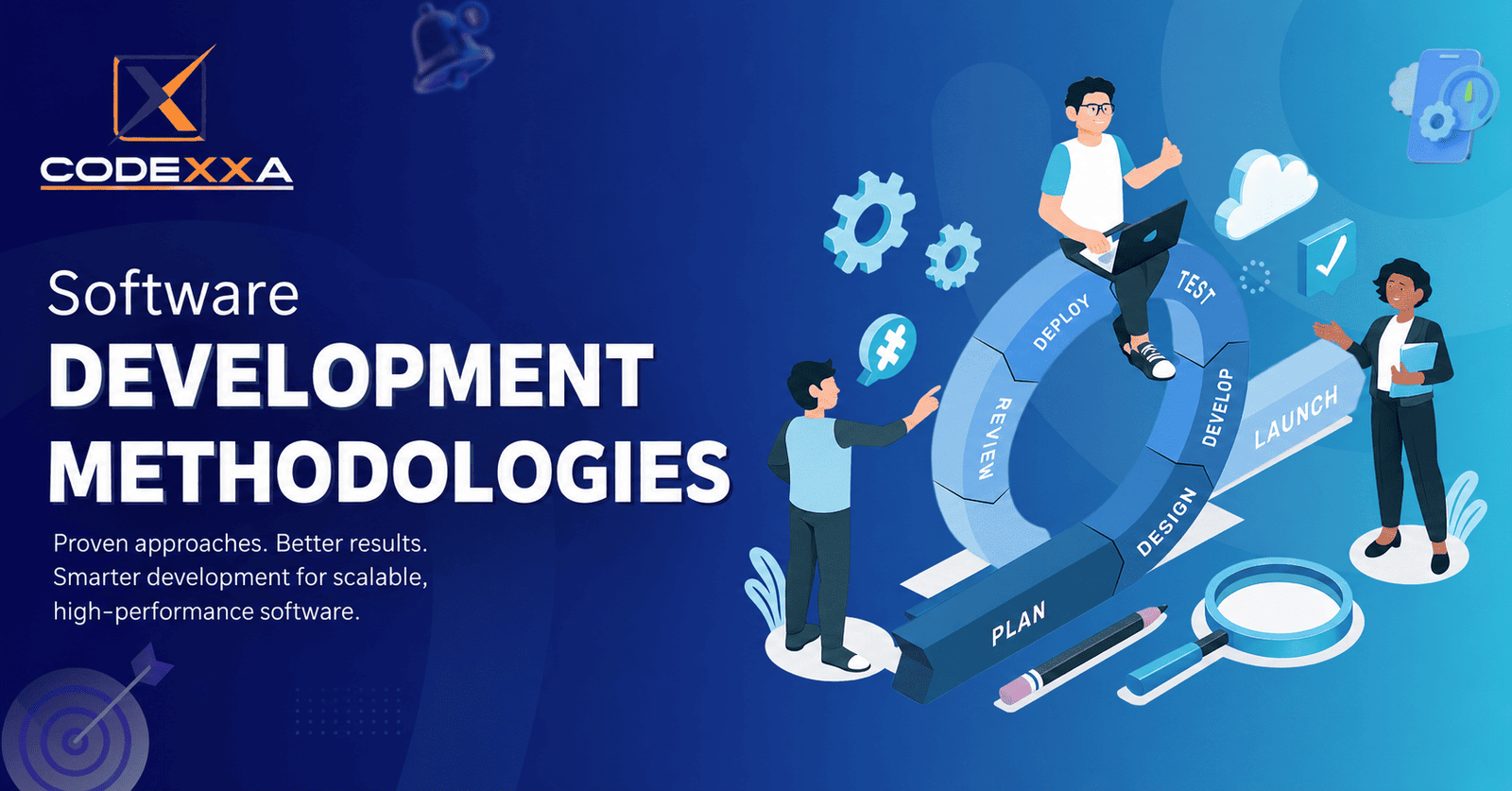
Choosing the right software development methodology plays a crucial role in the success of any software project. It shapes how teams plan, build, test, and deliver software efficiently.
Software development methodologies provide structured frameworks that guide teams through planning, development, testing, and deployment while maintaining collaboration, quality standards, and project clarity.
Different methodologies support different project environments, team structures, and development goals. Selecting the right model helps teams reduce risks, manage timelines, and improve product outcomes.
For example, traditional approaches such as the Waterfall model emphasize structured, sequential development phases, while Agile methodologies prioritize flexibility, collaboration, and continuous improvement.
Understanding these differences helps businesses and development teams choose a model that aligns with project complexity, budget flexibility, timeline expectations, and long-term scalability.
In this guide, we explore the most important software development methodologies, compare Agile vs Waterfall approaches, and explain how to choose the right development model.
What Are Software Development Methodologies?
Software development methodologies are structured approaches that guide how software is planned, designed, developed, tested, and deployed across complex technology projects.
Instead of building software randomly, teams follow defined workflows that organize development tasks into predictable stages with clear responsibilities.
These frameworks act as operational roadmaps, helping engineering teams coordinate work, manage requirements, and deliver stable software on schedule.
Most modern methodologies are built around the Software Development Life Cycle (SDLC), which divides development into phases like planning, design, coding, testing, deployment, and maintenance.
Understanding this structure matters because every methodology organizes these phases differently depending on project flexibility, risk management, and delivery speed.
Core stages typically included in structured software development:
- Planning – Defines business goals, project scope, feasibility, timelines, and technical requirements before development begins.
- System Design – Architects plan system structure, technology stack, data flows, and application architecture to support future scalability.
- Development – Engineers build core software functionality, features, and integrations according to defined requirements and architecture.
- Testing – Quality assurance teams validate performance, usability, security, and stability to ensure the software works as expected.
- Deployment – The application is released to production environments where real users can access and interact with the product.
- Maintenance – Development teams monitor performance, fix bugs, release updates, and improve the product continuously after launch.
Different software development methodologies manage these stages differently.
For example, the Waterfall model follows a strict sequential process, while Agile methodologies encourage iterative development with continuous feedback and improvements.
Why Choosing the Right Methodology Matters for Your Business
Software development methodology directly influences project timelines, costs, product quality, and long-term scalability of the application being built.
A poorly chosen development model often leads to unclear requirements, scope creep, missed deadlines, and rising engineering costs.
Industry reports show that up to 75% of software projects fail to meet goals, budgets, or timelines due to planning and process issues.
Choosing the right methodology reduces this risk by providing structured workflows, clear milestones, and predictable delivery cycles.
Key business outcomes influenced by the development methodology:
- Budget Control – Choosing the right methodologies helps teams estimate resources accurately, preventing uncontrolled feature expansion and unexpected development costs.
- Timeline Predictability – Defined stages and iterative delivery cycles improve release planning and help businesses launch products faster.
- Flexibility for Requirement Changes – Adaptive methodologies allow teams to respond to evolving user needs without disrupting the entire development lifecycle.
- Product Scalability – Well-structured development processes ensure software architecture supports future growth, integrations, and performance demands.
- Business and Technical Alignment – A clear methodology improves collaboration between stakeholders, product managers, designers, and engineers.
Agile adoption data highlights this impact clearly.
64% of companies report improved software delivery after adopting Agile development approaches within their engineering workflows.
Additionally, Agile-driven projects show higher success rates compared to traditional models because iterative feedback reduces risk early.
For businesses investing in digital products, selecting the right development methodology becomes a strategic decision rather than a technical preference.
Top Software Development Methodologies Businesses Should Know
Modern software projects require a structured development methodology to manage complexity, accelerate releases, and maintain product quality across evolving business requirements.
Below are widely used software development methodologies that businesses evaluate before starting product development or scaling digital platforms.
1. Waterfall Model in Software Engineering
The Waterfall model is one of the earliest software development methodologies, following a strict linear sequence across SDLC phases.
In real engineering environments, this model enforces heavy documentation and milestone-driven execution before implementation begins.
Every phase must be completed before the next one begins, making accurate planning and clear requirements critical for successful project delivery.
Typical phases of the Waterfall development process:
- Requirements Gathering – Teams produce a Software Requirement Specification (SRS) documenting functional requirements, system constraints, and expected product behavior.
- System Design – Architects translate SRS documents into High-Level Design (HLD) and Low-Level Design (LLD), defining system architecture and module interactions.
- Development – Engineers implement application modules based on design documentation while performing unit-level validations during coding.
- Testing – Quality assurance teams conduct integration testing, system testing, and acceptance testing to validate product stability and alignment with requirements.
- Deployment – The application is released into production infrastructure after validation and configuration within staging or controlled environments.
- Maintenance – Post-release support includes corrective fixes, performance improvements, and system updates responding to operational feedback.
When engineering teams typically adopt the Waterfall model:
- Projects with stable, clearly defined requirements.
- Enterprise systems requiring strict documentation.
- Regulated environments such as healthcare, banking, and government systems.
- Infrastructure platforms where architecture changes are costly.
Advantages of the Waterfall model:
- Clear phase-based project governance.
- Strong documentation supporting compliance audits.
- Predictable scheduling for fixed-scope enterprise systems.
Limitations engineering teams must consider:
- Requirement changes are difficult once development begins.
- User feedback appears late in the development lifecycle.
- Limited flexibility compared with iterative development models.
Despite Agile adoption across startups, Waterfall remains useful for compliance-heavy systems and projects demanding predictable engineering execution.
2. Agile Software Development Methodology
Agile software development emphasizes iterative delivery, continuous feedback, and cross-functional collaboration to build software incrementally and adapt to changing requirements.
Instead of delivering a single large release, Agile teams ship working features in short development cycles called iterations or sprints.
Typical development flow used in Agile engineering environments:
- Requirement Planning – Product teams define user stories, prioritize backlog items, and align features with business value and user outcomes.
- Sprint Planning – Development teams select backlog tasks and define sprint objectives for the upcoming iteration cycle.
- Iterative Development – Engineers build features incrementally using version control, modular architecture, and continuous integration practices.
- Continuous Testing – QA engineers validate functionality within each sprint rather than waiting until the final development stages.
- Sprint Review – Teams demonstrate working features to stakeholders and collect actionable feedback for upcoming iterations.
- Retrospective – Engineering teams evaluate sprint performance and refine workflows to improve development efficiency.
Advantages of Agile development:
- Faster product releases through iterative feature delivery.
- Continuous user feedback improves product-market alignment.
- Higher collaboration between developers, designers, and product stakeholders.
- Reduced risk by identifying issues early during development cycles.
Limitations engineering teams should consider:
- Frequent requirement changes may introduce scope management challenges.
- Large teams may struggle with coordination across multiple Agile iterations.
- Agile requires consistent stakeholder involvement during development cycles.
Because Agile supports continuous improvement and adaptability, it has become one of the most widely adopted methodologies in modern software engineering teams.
3. Scrum Methodology Explained
Scrum is a lightweight Agile software development methodology designed to help engineering teams deliver working software through short, structured development cycles.
Instead of long development timelines, Scrum divides work into time-boxed iterations called sprints that typically last two to four weeks.
Each sprint focuses on delivering a small but functional increment of the product that can be tested and improved quickly.
Key roles involved in a Scrum development team:
- Product Owner – Responsible for defining product vision, prioritizing the backlog, and ensuring development aligns with business objectives.
- Scrum Master – Facilitates Scrum practices, removes workflow blockers, and ensures teams follow Agile principles effectively.
- Development Team – Cross-functional engineers responsible for designing, building, testing, and delivering product increments.
Core Scrum workflow used in software teams:
- Product Backlog – A prioritized list of product features, user stories, and improvements maintained by the Product Owner.
- Sprint Planning – Teams select backlog items and define sprint goals before development begins.
- Daily Scrum – A short daily meeting where developers discuss progress, blockers, and planned work.
- Sprint Review – Teams present completed work to stakeholders and gather feedback.
- Sprint Retrospective – Teams analyze sprint performance and identify workflow improvements.
Advantages of Scrum methodology:
- Faster feature delivery through short development cycles.
- Improved team transparency through daily progress discussions.
- Higher product adaptability through regular stakeholder feedback.
- Better collaboration across development, design, and product teams.
Limitations engineering teams should consider:
- Requires disciplined team participation and consistent communication.
- Frequent meetings may reduce development time if poorly managed.
- Scaling Scrum across large distributed teams can introduce coordination challenges.
Scrum has become one of the most widely adopted Agile methodologies because it balances structured planning with rapid product iteration.
4. DevOps Methodology
DevOps is a modern software development methodology focused on integrating development and operations teams to deliver software faster and more reliably.
Instead of separating development and infrastructure teams, DevOps encourages shared responsibility across coding, testing, deployment, and system monitoring.
This approach improves delivery speed by automating repetitive processes such as integration, testing, deployment, and infrastructure configuration.
Key DevOps practices used in modern engineering teams:
- Continuous Integration (CI) – Developers frequently merge code changes into shared repositories where automated builds and tests validate software stability.
- Continuous Delivery (CD) – Automated pipelines prepare tested code for deployment, enabling rapid and reliable releases.
- Infrastructure as Code (IaC) – Infrastructure configuration is managed through code to ensure consistent environments across development and production systems.
- Automated Monitoring – Systems continuously track application performance, infrastructure health, and system errors in real-time.
- Continuous Feedback – Operational insights guide development teams to improve software performance and reliability.
Advantages of DevOps methodology:
- Faster software releases through automated deployment pipelines.
- Improved collaboration between engineering and operations teams.
- Higher system reliability through continuous monitoring and feedback.
- Reduced deployment risks with automated testing and validation.
Limitations engineering teams should consider:
- Requires strong automation infrastructure and tooling investments.
- Cultural shift is needed for collaboration between traditionally separate teams.
- Security and compliance must be integrated carefully within DevOps workflows.
Organizations adopting DevOps report significantly improved deployment frequency and faster incident recovery times across software delivery pipelines.
5. Spiral Model
The Spiral model is a risk-driven software development methodology combining iterative development with risk analysis across repeated development cycles.
Instead of executing phases once, development progresses through spiral iterations where planning, risk analysis, engineering, and evaluation repeat continuously.
Each loop of the spiral represents a full development cycle where teams analyze risks before committing significant engineering resources.
Typical phases in a Spiral development cycle:
- Planning – Teams define project objectives, analyze requirements, and explore alternative technical solutions before entering development.
- Risk Analysis – Architects evaluate technical, financial, and operational risks while validating feasibility through prototypes or proof-of-concept implementations.
- Engineering – Development teams design, implement, and test software components based on decisions made during planning and risk evaluation.
- Evaluation – Stakeholders review the iteration output and determine improvements before initiating the next development spiral.
Advantages of the Spiral model:
- Early risk identification prevents architectural failures in large and complex software systems.
- Iterative development enables continuous validation and stakeholder feedback.
- Suitable for mission-critical systems requiring strict risk management.
Limitations engineering teams should consider:
- Spiral methodology requires experienced teams capable of performing detailed risk analysis.
- Project costs increase due to repeated evaluation and prototyping cycles.
- Not ideal for small projects with limited budgets or low technical uncertainty.
The Spiral model is commonly adopted for large, high-risk software systems where requirements evolve, and risk management is critical.
6. V-Model (Verification and Validation Model)
The V-Model is a software development methodology extending the Waterfall by linking every development phase with a corresponding testing phase.
Instead of delaying testing until the end, validation activities run parallel to development stages to detect defects earlier.
The model forms a “V” shape where the left side represents verification activities and the right side represents validation testing.
Typical development and testing alignment used in the V-Model:
- Requirements Analysis – System requirements are defined while acceptance test plans are prepared to validate business and user expectations.
- System Design – High-level architecture decisions are made while integration testing strategies are planned.
- Detailed Design – Individual modules are specified, while unit testing scenarios are prepared for validating module functionality.
- Implementation – Developers build application components while executing unit tests to confirm module behavior.
- Integration Testing – Combined modules are validated to confirm correct communication and system interaction.
- System Testing – The entire application undergoes testing against functional and performance requirements.
- User Acceptance Testing – Stakeholders verify the product in production-like environments before final deployment.
Advantages of the V-Model:
- Early testing reduces defect propagation across later development stages.
- Clear mapping between development phases and testing improves traceability and quality control.
- Well-structured documentation supports safety-critical and regulated software environments.
Limitations engineering teams should consider:
- Rigid process structure makes adapting to evolving requirements difficult.
- Heavy documentation and sequential phases can extend project timelines.
- Less suitable for rapidly changing products requiring continuous iteration.
Because of its strong validation structure, the V-Model is commonly used in aerospace, defense, healthcare, and embedded systems development.
7. Hybrid Software Development Models
Hybrid software development combines elements of multiple methodologies, typically blending Waterfall’s structured planning with Agile’s iterative development flexibility.
In many enterprise environments, teams plan architecture and requirements using Waterfall principles, then implement features through Agile iterations.
Common pattern used in Hybrid development environments:
- Strategic Planning – Teams define architecture, compliance requirements, scope boundaries, and delivery milestones using structured planning approaches.
- Iterative Development – Product features are built in Agile sprints, allowing rapid delivery and continuous feedback.
- Continuous Validation – Teams integrate automated testing, code reviews, and feedback cycles across iterations.
- Controlled Releases – Production deployments follow defined release management policies aligned with enterprise governance requirements.
Advantages of Hybrid development models:
- Combines Agile flexibility with the predictability of structured project planning.
- Improves collaboration between engineering, operations, and business stakeholders.
- Supports complex enterprise systems requiring compliance and architectural stability.
Limitations engineering teams should consider:
- Hybrid implementation requires strong coordination across teams using different development workflows.
- Poor integration between Agile and traditional planning processes can create delivery bottlenecks.
- Requires experienced project leadership to balance flexibility with governance.
Many large organizations adopt hybrid development when projects require predictable planning while still supporting iterative software delivery.
How to Choose the Right Software Development Methodology for Your Project
Selecting the right software development methodology determines how efficiently teams manage scope, risks, timelines, and long-term product scalability.
Projects using proper methodologies significantly see more success compared with ad-hoc development processes without defined frameworks.
Key factors businesses should evaluate before selecting a development methodology:
- Project Size and Complexity – Large systems with multiple integrations require structured architecture planning and robust development governance.
- Budget Flexibility – Iterative methodologies like Agile support changing priorities, while fixed-scope projects often require predictable cost structures.
- Timeline Urgency – Products targeting fast market entry benefit from incremental releases instead of long sequential development cycles.
- Regulatory and Compliance Requirements – Healthcare, banking, and government systems often require structured documentation and traceability across development stages.
- Stakeholder Involvement – Projects requiring continuous feedback benefit from iterative models, enabling regular product reviews and feature adjustments.
Quick evaluation framework used by engineering teams:
| Project Scenario | Recommended Methodology |
|---|---|
| Rapid product iteration | Agile or Scrum |
| Enterprise systems with strict compliance | Waterfall or V-Model |
| Large high-risk technical systems | Spiral Model |
| Continuous deployment environments | DevOps methodology |
| Mixed governance and flexibility needs | Hybrid development model |
The ideal methodology depends on project constraints, team expertise, and business objectives rather than choosing the most popular.
Start Your Web Developement Project
Conclusion
Choosing the right methodology directly influences development efficiency, team collaboration, system scalability, and long-term software maintainability.
Today, many modern organizations combine multiple methodologies to balance structured planning with the flexibility required for continuous product improvement.
Therefore, businesses building scalable digital products must evaluate their projects based on scope, compliance requirements, team expertise, and delivery timelines to select the right development methodology. Doing this early can prevent architectural rework, reduce technical debt, and improve long-term product maintainability.
If you're planning a custom software product, choosing the right development methodology can significantly impact product success and engineering efficiency.
At Codexxa, our development teams help businesses select the most effective software development methodology to build scalable, future-ready software solutions. Contact us to get an expert’s help!